





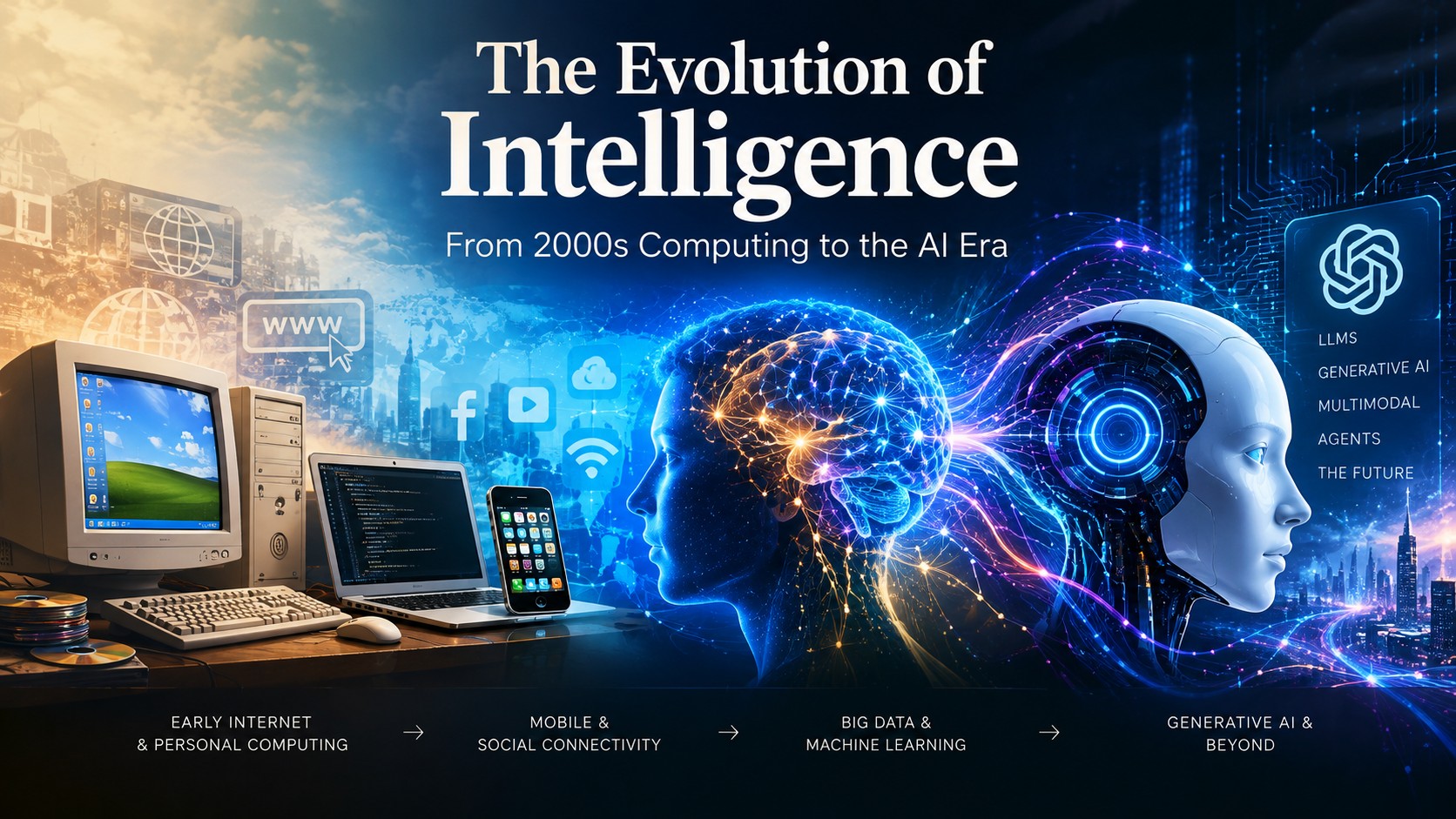
It all started in the 2000s when I was a kid trying to figure out what computers actually do and how the internet works. When I first encountered computers at age eleven, I was fascinated by the idea of building things more intelligently. By the time I got my first mobile phone, it felt like the bridge between computers and the internet had landed right in the palm of my hand. Over time, personal progression has led us to a place where I now use the internet and computing simply as everyday tools to get things done. When I first heard about artificial intelligence, my initial impression was that it would essentially be a more sophisticated version of Google. Yet, claims surrounding AI suggest something far more profound: that it can exceed human cognition. The internet and personal computing have successfully transitioned from novel technological marvels into invisible, ubiquitous infrastructure. we rely on digital tools seamlessly as household utilities to manage our daily personal and professional lives.When artificial intelligence first entered mainstream awareness, many dismissed it as merely an advanced search engine or a minor upgrade to existing automation. However, current breakthroughs reveal a paradigm shift: AI possesses the capability to augment, complement, and in specific domains, exceed traditional human cognitive limits.
Modern society currently operates at an unprecedented peak in the consumption and production of digital media, software, and services.Drawing a comparison to the rapid commercial rollout of the internet during the 2000s, we are witnessing a similar hyper-accelerated adoption curve driven by generative AI. Industry leaders forecast that continuous feedback loops between user adoption and model training will deepen societal and structural reliance on intelligent systems. In terms of automation, society has reached an unprecedented peak in the consumption of digital goods. We have leveraged combinations of the internet and computing to create remarkable software products. However, drawing a parallel to the internet of the 2000s, we can see a similar rapid rollout cycle repeating with AI features today. Global tech giants predict that system feedback loops will create deeper societal dependencies on this technology down the line.
I believe this is a rapid process of integration that demands genuine awareness and serious skill. Not all businesses and enterprises are fully prepared for this technological shift. Compounding this, financial models built on custom subscription packages for various cloud-based services mean that organizational operations must align with these incredible capabilities at a mind-blowing rate. For the first time, AI has reached a threshold where it genuinely exceeds human cognition. This rapid technological integration requires conscious strategic awareness and specialized digital literacy. Unfortunately, many enterprises and organizations remain unprepared for the speed of this shift.The widespread adoption of custom cloud subscription packages and AI-as-a-Service models means that businesses must align their operational frameworks with superhuman capabilities at an unprecedented tempo.
The Boom is already here, recently companies like Anthropic, OpenAI and Google launched their new models GPT5, fable and spark respectively. Already MetaAI has launched their glasses with AI in it. Sooner or later it would be connected to your automobile where your car talks to you. Another internet trend where coders meet their flow state over a ChatGPT subscription. Tech savvy enthusiasts are rolling out their credit cards to buy AI credits., sooner or later it would be called AI as a Service (AAAS) which combines cloud services and AI. We are witnessing an exponential innovation in AI. As generative tools evolve from experimental novelties into production-ready suites, understanding the craft behind the prompt is more critical than ever. Artificial Intelligence(AI) is a technology that enables computers and machines to simulate human learning, comprehension, problem solving, decision making, creativity and autonomy. Professionals across industries are entering deep “flow states” powered by advanced subscription tooling. Simultaneously, everyday consumers are leveraging automated financial mechanisms to procure AI compute credits, paving the way for AAAS.Redefining the Craft of Prompting: As generative systems evolve from experimental novelties into production-ready enterprise suites, mastering the nuance of human-AI communication and prompt engineering has become a critical core competency. Artificial intelligence now serves as a foundational technology that empowers machines to simulate human learning, complex problem-solving, creative execution, and autonomy.
WHAT DO WE DO NOW ?
Here is a quick info that is around the corner, running through October 2026,
The virtual workshop series features co-hosted sessions pairing real-world project walkthroughs with candid tips and live Q&A. The current agenda includes:
Google Flow for Beginners (Thu, 8 October 2026): An introductory look at setting up the studio environment and getting comfortable with core generative tools.
Google Flow for Creators (Mon, 12 October 2026): Focused on accelerating content creation pipelines for digital platforms.
Google Flow for Filmmaking (Fri, 16 October 2026): Exploring cinematic generation, storyboarding, and scene expansion.
Google Flow for Hybrid Production | Filmmaking & Advertising (Fri, 23 October 2026): Bridging traditional commercial pipelines with AI-driven execution.
Google Flow for Design (Mon, 26 October 2026): Tailored workflows for graphic, product, and spatial design professionals.
The Google Flow workshop series offers an invaluable look under the hood, proving that the future of art isn’t about replacing the artist, but supercharging the human workflow.
link: https://flow.google.com/